

You finally decided to do something about your patio.
Maybe you are tired of retreating inside every July afternoon when the sun turns your deck into a griddle. Maybe you have given up one too many evenings to the mosquitoes. Or maybe you just want to actually use the outdoor space you have, without sunburning and swatting your way through it.
Two of the most popular upgrades Eastern Iowa homeowners are adding right now are patio covers and pull-down retractable screens. And the next question almost everyone asks is:
What is this going to cost me?
In this week’s StraightTALK, we are breaking down real pricing ranges, explaining what drives those numbers, and helping you understand the difference between a patio cover investment and a pull-down screen investment so you can make a confident decision for your home.
How much does a patio cover cost?
Patio cover costs in Eastern Iowa typically range from $10,000 to $30,000 or more, installed, depending on the size of the space, whether you are adding electricity or styling upgrades, and whether the cover is being built over an existing deck or a ground-level patio. A basic attached patio cover sits at the lower end of that range, while covers with added electrical work, custom styling, or deck-related foundation work climb higher.
That is a wide range because patio covers are not a commodity product with a fixed price tag. They are built to fit your home, and a handful of choices you make along the way shape the final number. To give you a better sense of where projects tend to land, here is how pricing generally breaks down.
Standard Attached Patio Covers
A standard attached patio cover is the most straightforward version of this project. No fan, no electrical work, no pergola-style roofline detailing. Just a solid roof structure attached to your home that provides reliable overhead shade and weather protection. These typically start somewhere in the $10,000 to $15,000 range for a modest-sized project and are a great fit for homeowners who want to add shade and rain protection to their outdoor space.
Patio Covers with Electrical and Styling Upgrades
Many homeowners choose to add a ceiling fan, lighting, or decorative styling touches, like a roofline detail that mimics the look of a pergola, to their patio cover. These additions bring the project into the $15,000 to $25,000 range, depending on how much electrical work is involved and how custom the styling gets. A fan alone can make a covered patio usable on far more days out of the year, so this upgrade tends to pay for itself in actual use and time spent on your patio.
Patio Covers Attached to an Existing Deck
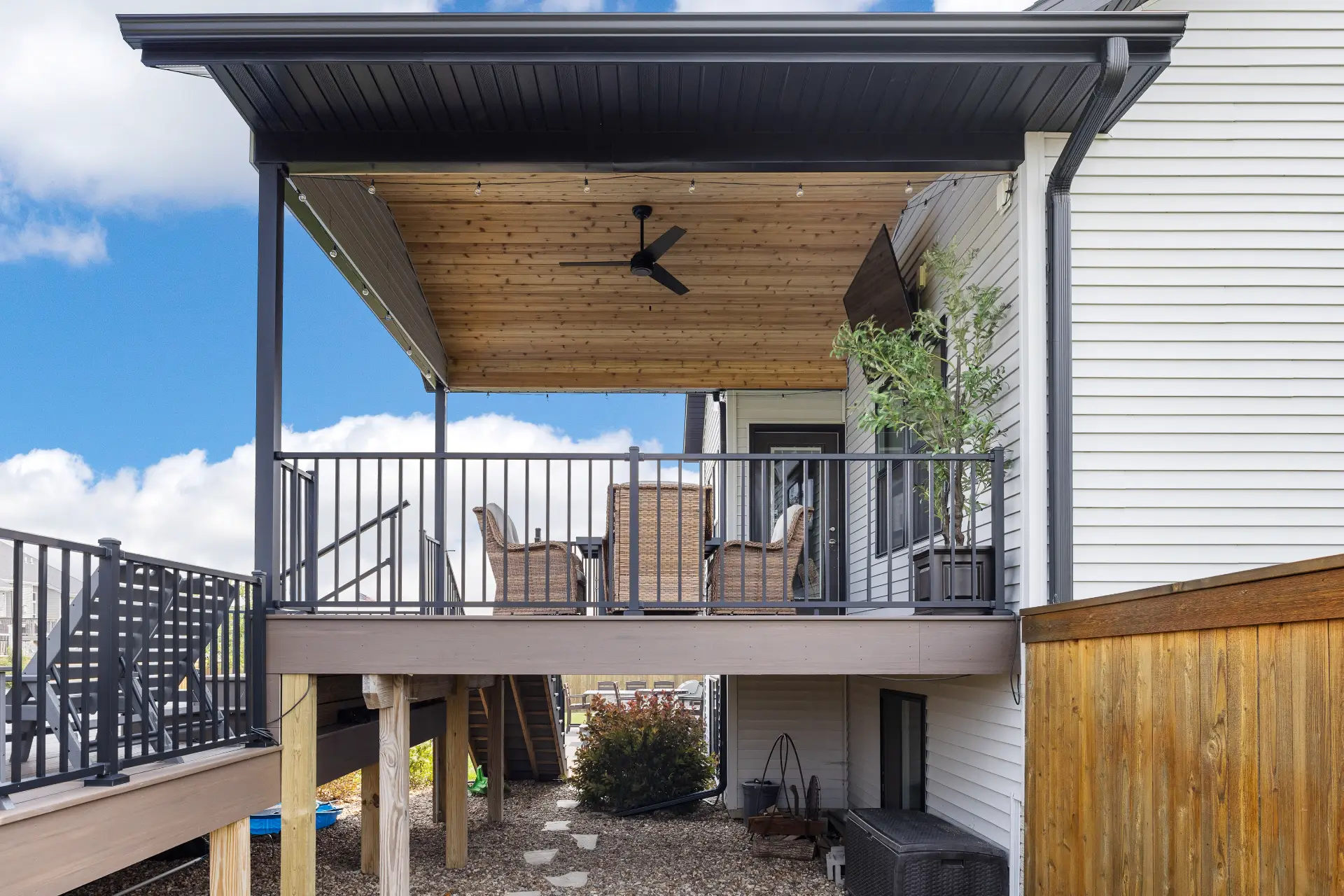
If you already have a deck and want to add a cover over it, the project can sometimes cost more than a ground-level patio cover. It depends entirely on your deck’s current foundation. If the existing footings and structure are solid and built to support the additional weight of a roof, the project moves forward fairly simply. If the foundation needs to be reinforced or rebuilt to safely carry the new structure, that adds cost. These projects can range anywhere from $15,000 into the $30,000s, depending on what your deck’s foundation actually requires.
StraightTALK Remodeling Tip
When comparing patio cover quotes, make sure you are comparing the same thing. A $9,000 quote and an $18,000 quote can both be for “patio covers” while referring to completely different scopes of work. Ask whether electrical, styling, or foundation work is included, and what warranty backs the installation.
What factors drive patio cover costs up?
The biggest cost drivers for a patio cover are the size of the space, whether you add electrical components like a fan or lighting, whether you choose styling upgrades to the roofline, and whether the cover is attached to an existing deck that may need foundation work. Permit requirements can also add cost, depending on your municipality. Here is a closer look at what moves the number in either direction.
Patio Cover Size
This one is pretty straightforward. More square footage means more materials and more labor. A 10×12-foot cover over a small patio is a very different project than a 20×20-foot cover spanning a large outdoor living area.
Electricity for Fans and Lighting
A standard patio cover does not include any electrical work. Once you add a ceiling fan, recessed lighting, or both, you are adding wiring, fixtures, and labor to run power to the structure. This is one of the most common upgrades homeowners choose, and for good reason. A fan can make a covered patio comfortable on days that would otherwise be too hot or too still to enjoy.
Patio Cover Styling Upgrades
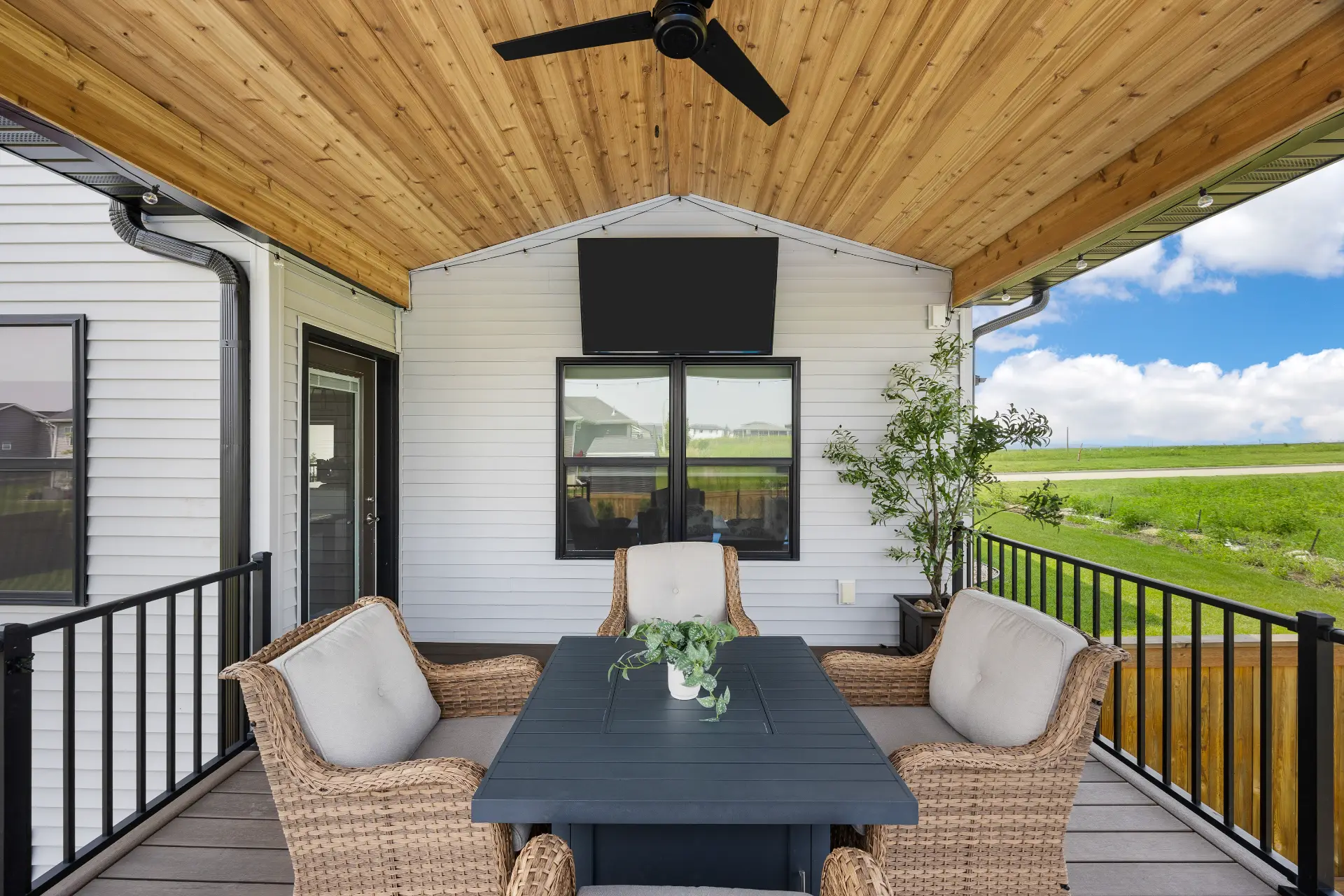
Some homeowners want their patio cover to be more than just functional. Roofline detailing that mimics the look of a pergola, decorative beams, or upgraded trim and finishes all fall into this category. These touches add cost but can significantly elevate how the finished structure looks against your home.
Attaching a Patio Cover to an Existing Deck
This is where costs can vary the most. If you are adding a cover to a patio at ground level, the foundation work is usually simpler, if we don’t have to re-pour the patio. If you are adding a cover over an existing deck, everything depends on what is already there. A deck built to current code with solid footings may need little to no extra structural work. A deck with an older or undersized foundation may need to be reinforced or partially rebuilt before it can safely support a roof. A professional inspection during your consultation is the only way to know for sure which situation you are in.
Permitting
Most municipalities require permits for permanent structures like patio covers, including Cedar Rapids, Hiawatha, and Iowa City. Permit fees and requirements vary by city. Hometown Restyling handles this process as part of the project, but it is worth knowing it factors into your overall timeline and cost.
StraightTALK Remodeling Tip
If you are building a patio cover over an existing deck, ask for a foundation assessment before you get attached to a final price. The condition of what is already there has a bigger impact on cost than almost anything else in this category.
What types of pull-down screens are available, and where can they be installed?
Pull-down (or retractable) shade screens can be installed on covered porches, pergolas, garages, and enclosed patios. Essentially anywhere with an overhead structure to mount the housing. They come in two primary configurations (manual spring-assisted and motorized remote-controlled) and two primary mesh types: insect screens and solar shade screens.
Pull-down screens are one of the more versatile upgrades available for Eastern Iowa homes because they work across so many different spaces. Here is how homeowners are actually using them.
Pull-Down Screens for Patio and Deck Openings
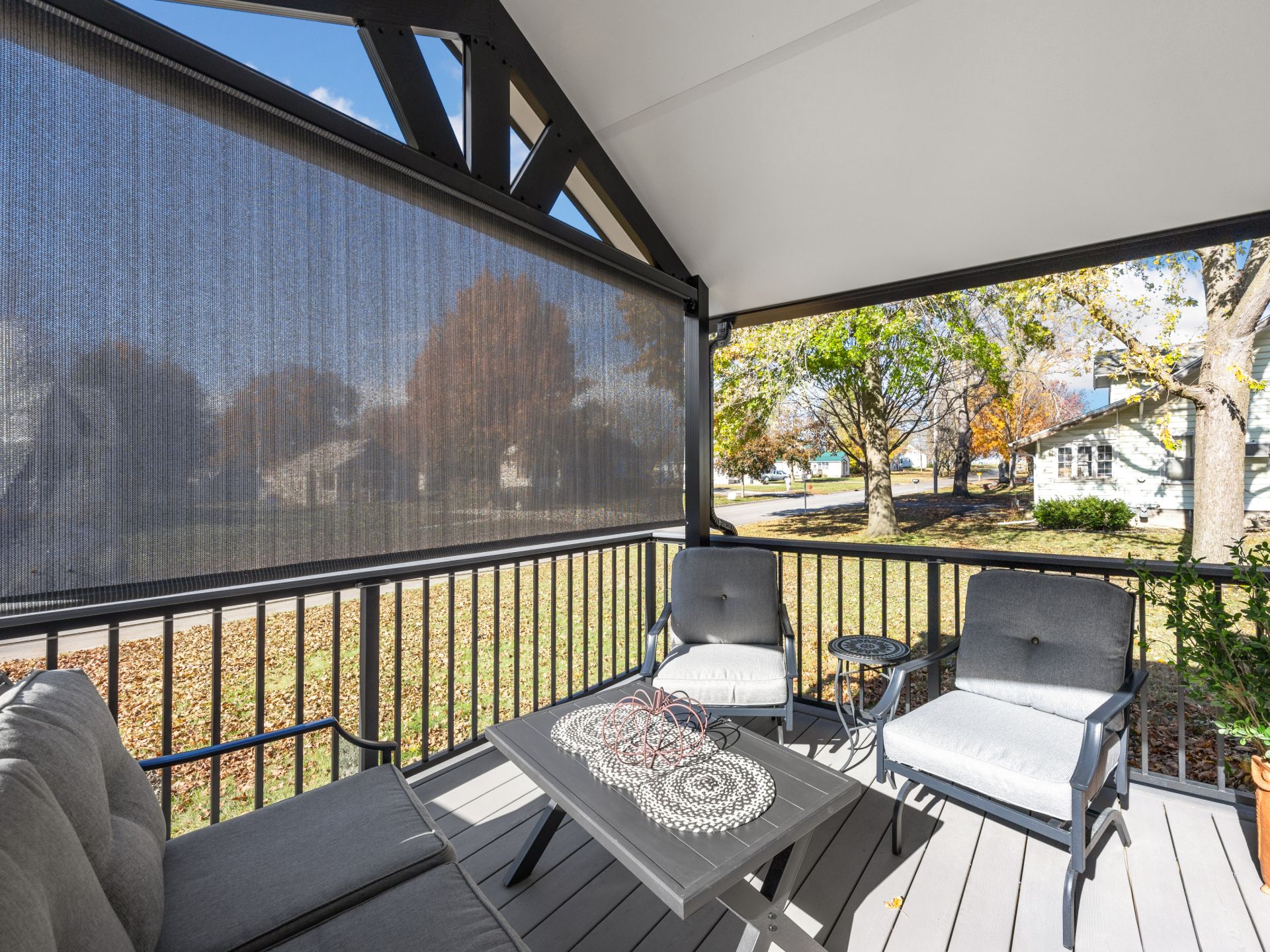
A pull-down screen installed across the open face of a covered patio creates an instant bug barrier and can add meaningful shade if you choose a solar mesh. The screen housing mounts overhead and is virtually invisible when retracted. When you need it, it drops in seconds. Pull it down, enjoy your evening, done.
Pull-Down Screens for Garages
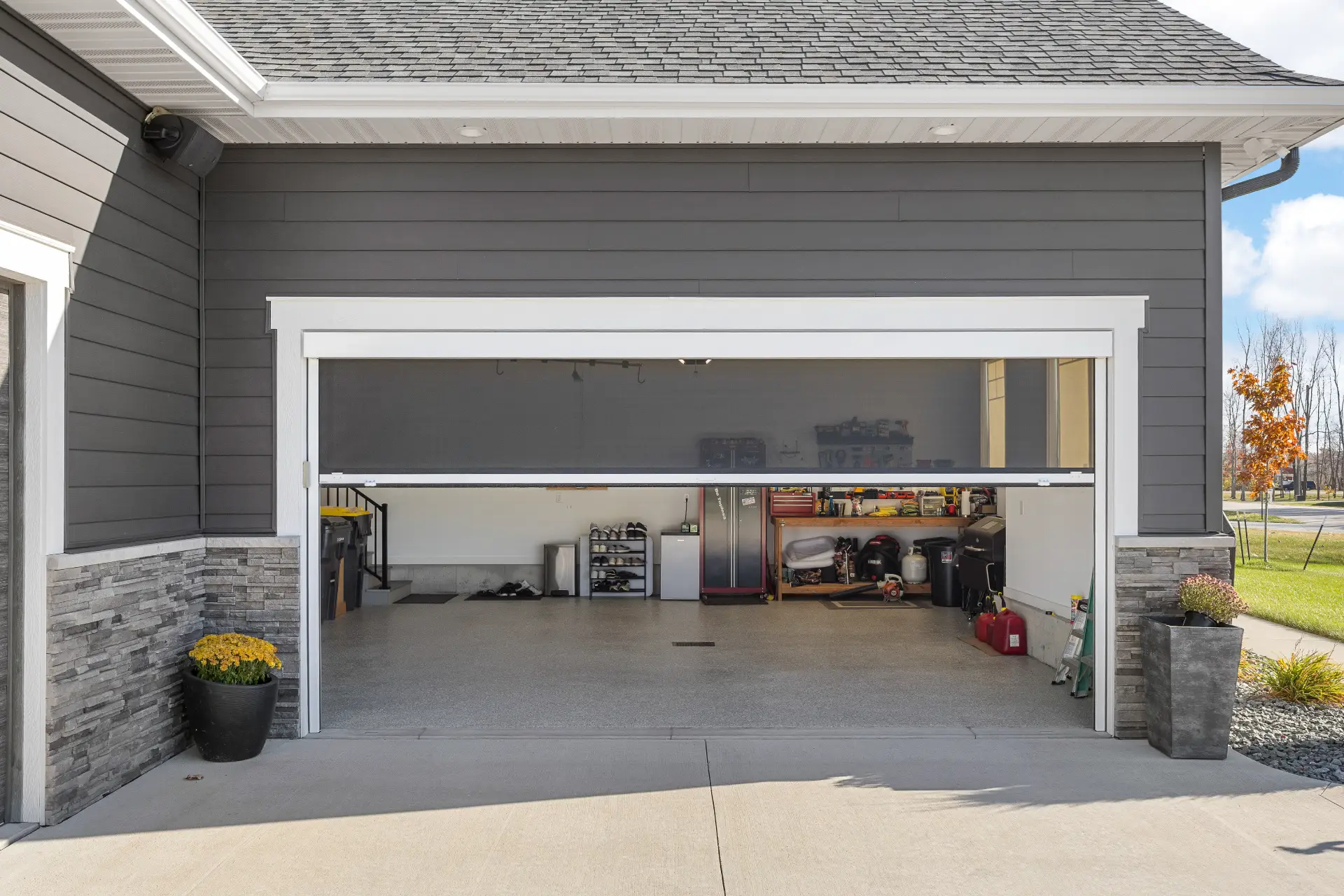
This is one of the most popular applications Hometown Restyling installs, and honestly, it is one of our favorites to show homeowners. A pull-down screen across a garage opening transforms the space into a shaded, bug-free hangout for the summer. With the garage door up and the screen down, you get airflow without the mosquitoes. Screens are available for single-car and double-car openings.
Retractable Screens Can Enclose Patios and Porches
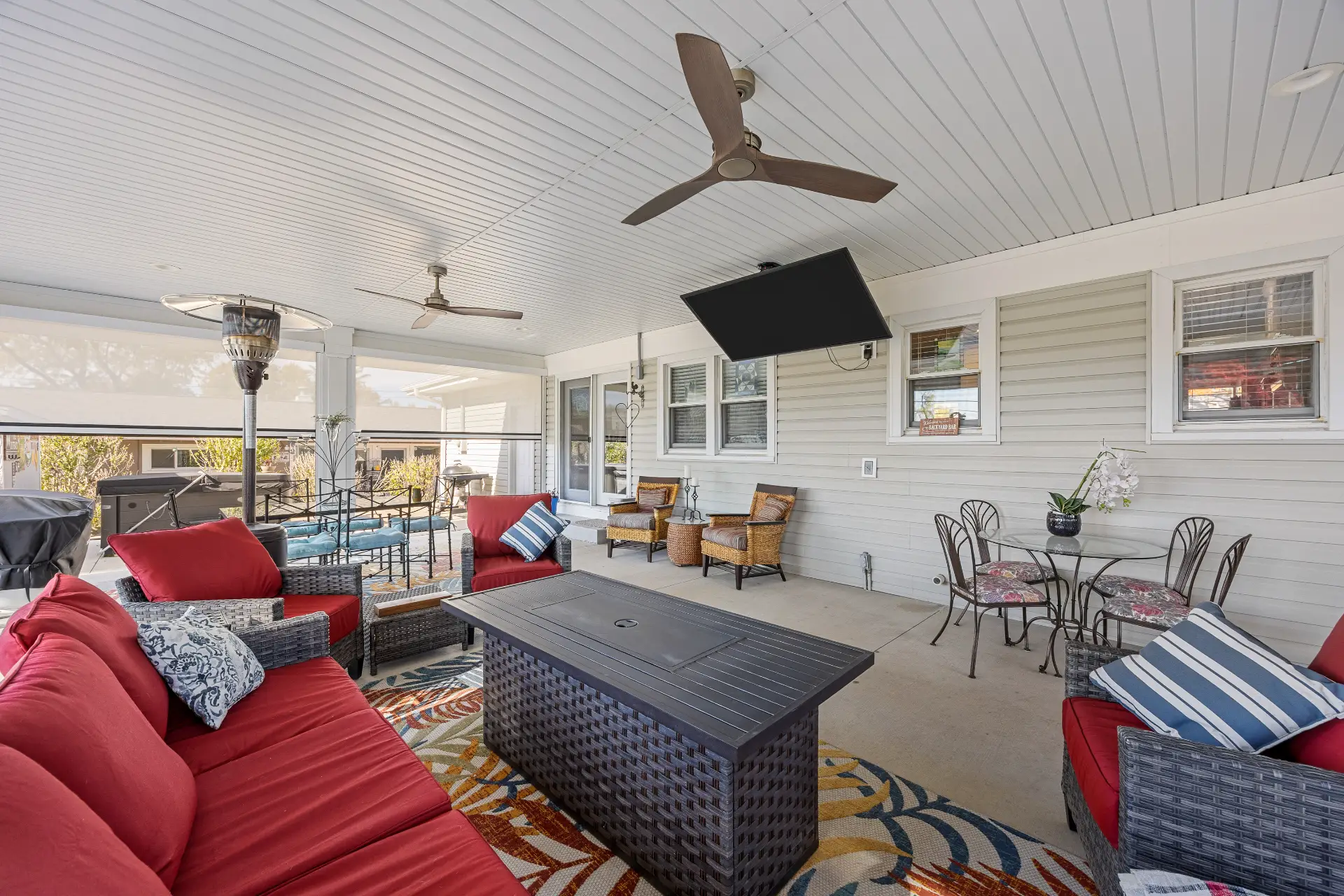
For covered porches or enclosed patios with open wall sections, a pull-down screen fills those openings cleanly without permanently enclosing the space. When the weather turns, retract the screens and restore the full open-air feel. Best of both worlds.
Manual vs. Motorized Pull-Down Shade Screens
Manual screens use a spring-assisted pull bar. You pull the screen down to your desired position, lock it in place, and release it to retract. They are simple, reliable, and cost-effective. A strong choice for openings you use regularly but do not need the convenience of remote operation.
Motorized screens operate with a remote control and, on some systems, a smartphone app. They include an automatic obstruction stop for safety and are especially well-suited for larger openings and frequently used spaces where convenience is worth the additional investment.
Hometown Restyling installs Stoett retractable screen systems, an American-made manufacturer known for high-grade aluminum frames and heavy-duty mesh that resists deterioration, punctures, tears, and mildew. The side retention system provides a wind safety rating of up to 30 mph. For severe weather, screens can be quickly retracted.
Screen Mesh Options for Pull-Down Shade Screens
Insect mesh uses a fine-weave construction to block mosquitoes, flies, and gnats while maximizing airflow. For most Eastern Iowa homeowners, this is the right starting point because bugs are the primary complaint.
Solar shade mesh is denser and blocks UV rays and radiant heat, available in options that filter 80%, 90%, or 95% of UV. It reduces glare and heat noticeably, especially on a west-facing patio or in a garage that gets hammered by afternoon sun. Frame and fabric colors are available in a wide range, including black, charcoal, granite, bone, sandstone, white, espresso texture, and more.
StraightTALK Remodeling Tip
Not sure whether you need insect mesh or solar shade mesh? Ask yourself what is driving you inside. If it is bugs, insect mesh is your answer. If it is heat, solar shade is worth the upgrade. And if it is both, solar shade screens also block insects, so they do double duty.
How much do pull-down retractable shade screens cost?
Pull-down retractable screens installed by a professional typically range from $3,000 to $7,000 or more per opening (or side of your patio), depending on the width of the opening, whether the system is manual or motorized, and the mesh type selected. Manual systems for standard openings sit at the lower end. Motorized systems for larger garage or patio openings sit at the higher end.
It helps to know exactly what counts as one opening, since this is where total project cost can grow quickly. An opening is a single screened section, such as one side of a covered patio or one garage door. If you are screening a patio with three open sides, that is three openings, and the total cost is roughly three times the per-opening range above. The same goes for a garage with two separate door openings. Once you know how many openings your space actually needs, you can multiply from there to get a realistic project total.
Here is a general sense of how pricing breaks down per opening.
Manual Pull-Down Screens
For a standard patio or porch opening in the 4- to 8-foot range, a professionally installed manual retractable screen system generally runs in the $3,000 to $5,000 range. These are spring-assisted systems that are simple to operate and straightforward to install on most covered structures.
Motorized Pull-Down Screens
Motorized systems carry a higher price tag due to the motor, control system, and installation of electrical components. For a typical 12- to 13-foot opening, which is a common single-car garage width or medium patio span, professionally installed motorized systems generally run in the $4,000 to $5,500 range. Larger openings, like a double-car garage or wide patio span of 20 feet or more, can reach $5,000 to $8,500 or more.
Multiple Openings
Many homeowners add screens to more than one opening in a single project. For example, all sides of a covered patio, or a garage plus a porch opening. Installing multiple screens in one visit can be more cost-efficient than separate projects and lets you plan the whole space at once.
StraightTALK Remodeling Tip
If you are already investing in a patio cover, it is worth asking about pull-down screens at the same time. Combining both into one project can save on installation costs and lets you plan the complete outdoor space from the start, rather than adding screens later and working around an existing structure.
What factors drive pull-down screen costs up?
The biggest cost drivers for pull-down screens are opening width, manual vs. motorized operation, and mesh type. Installation complexity, the number of openings, and whether electrical work is required for motorized systems also affect the final price.
Opening Width
This is the single largest cost driver. A 4-foot screen opening is a fundamentally different product from a 20-foot screen opening: more material, a larger housing unit, and for motorized systems, a more robust motor. Pricing scales with width, so understanding how many openings you have and how wide they are is the first step in building an accurate budget.
Manual vs. Motorized
Motorized systems add meaningful cost over manual, typically in the range of $1,000 to $2,000 more per opening depending on size. Whether that is worth it depends on how you use the space. For a garage opening you drop every time company comes over, motorized is a genuine quality-of-life upgrade. For a small porch screen you open twice a week, manual may be entirely adequate.
Mesh Type
Solar shade mesh typically costs more than insect mesh due to the denser weave and UV-blocking properties. The premium is generally modest, often a few hundred dollars per opening, but it adds up across multiple screens.
Electrical Requirements
Motorized screens need a power source. If your garage or patio does not have a conveniently located outlet, adding one adds to the overall project cost. It is worth discussing during your consultation so there are no surprises on installation day.
Structure Compatibility
Most covered patios, pergolas, enclosed porches, and garages are good candidates for pull-down screens. In some cases, the existing structure may require minor modifications to accommodate the screen housing. A Hometown Restyling specialist can evaluate your specific setup during a free in-home consultation.
StraightTALK Wrap-Up
If you have been wondering what it actually costs to make your patio or garage more comfortable this summer, now you have a real starting point.
Patio covers are a structural investment that ranges from roughly $10,000 to $30,000 or more, depending on size, electrical upgrades, styling, and whether you are building over an existing deck. Pull-down retractable screens are a more flexible, lower-entry upgrade that ranges from around $3,000 to $7,000 per opening, and they can often be added to a structure you already have.
What the right answer looks like for your home depends on your space, how you use it, what is driving you inside, and what you want to create out there. Those are questions worth talking through with someone who knows Eastern Iowa homes and has been doing this for a long time.
At Hometown Restyling, we have been helping homeowners in Cedar Rapids, Iowa City, Waterloo, the Quad Cities, and Cedar Falls make great outdoor living decisions for nearly 40 years. We will walk you through your options, give you a straight quote, and stand behind what we install. That is not just a tagline around here. It is how we have stayed in business since 1986.
Ready to get started? Check out our Patio Covers or Pull-Down Screens pages for inspiration, or reach out for a free consultation. We would love to help you enjoy your outdoor living space even more.
1. How much does a patio cover cost?
Patio cover costs in Eastern Iowa typically range from $10,000 to $30,000 or more, installed, depending on the size of the space, whether you are adding electricity or styling upgrades, and whether the cover is being built over an existing deck or a ground-level patio. A basic attached patio cover sits at the lower end of that range, while covers with added electrical work, custom styling, or deck-related foundation work climb higher.
2. What factors drive patio cover costs up?
The biggest cost drivers for a patio cover are the size of the space, whether you add electrical components like a fan or lighting, whether you choose styling upgrades to the roofline, and whether the cover is attached to an existing deck that may need foundation work. Permit requirements can also add cost, depending on your municipality.
3. What types of pull-down screens are available, and where can they be installed?
Pull-down (or retractable) shade screens can be installed on covered porches, pergolas, garages, and enclosed patios. Essentially anywhere with an overhead structure to mount the housing. They come in two primary configurations (manual spring-assisted and motorized remote-controlled) and two primary mesh types: insect screens and solar shade screens.
4. How much do pull-down retractable shade screens cost?
Pull-down retractable screens installed by a professional typically range from $3,000 to $7,000 or more per opening (or side of your patio), depending on the width of the opening, whether the system is manual or motorized, and the mesh type selected. Manual systems for standard openings sit at the lower end. Motorized systems for larger garage or patio openings sit at the higher end.
It helps to know exactly what counts as one opening, since this is where total project cost can grow quickly. An opening is a single screened section, such as one side of a covered patio or one garage door. If you are screening a patio with three open sides, that is three openings, and the total cost is roughly three times the per-opening range above. The same goes for a garage with two separate door openings. Once you know how many openings your space actually needs, you can multiply from there to get a realistic project total.
5. What factors drive pull-down screen costs up?
The biggest cost drivers for pull-down screens are opening width, manual vs. motorized operation, and mesh type. Installation complexity, the number of openings, and whether electrical work is required for motorized systems also affect the final price.